The Hidden Cost of Scaling: When Complexity Grows Faster Than Volume
Growth is usually the goal.
More vehicles. More customers. More bookings. Higher revenue. Better profitability.
For any company, those are healthy signs that the business is moving in the right direction. But there is another side of growth that tends to be excluded from the forecast.
As an operation expands, it might seem like it’s simply just processing more of the same. It’s not. It accumulates more customer requirements, more exceptions, more pricing models, more booking channels, more driver requirements, more administrative processes, and more decisions. It´s. Just. More.
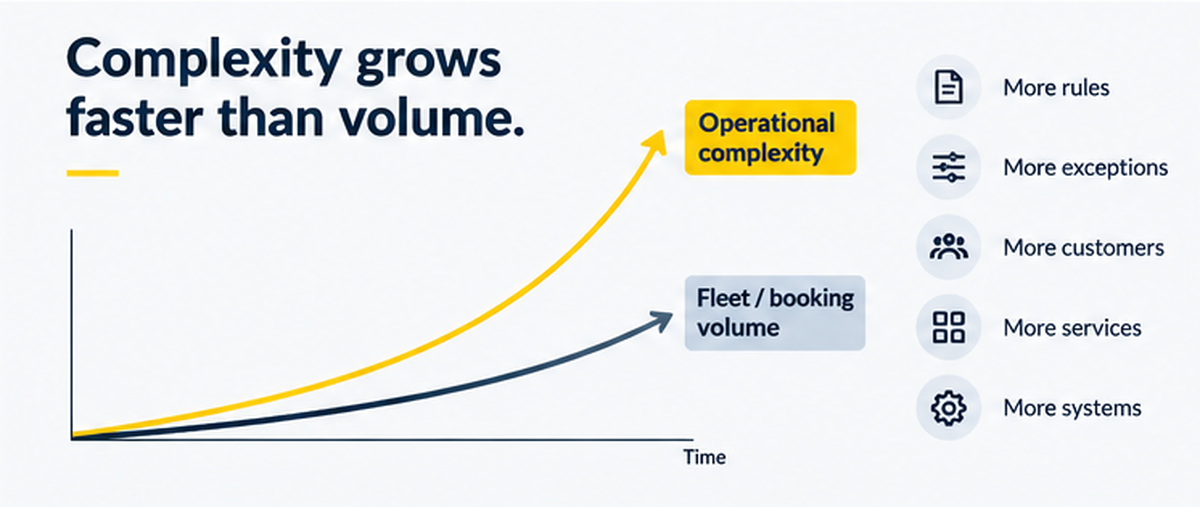
Complexity often grows faster than volume.
And when the systems, processes, and organization behind the fleet don´t grow at the same pace, that complexity starts consuming the very benefits growth was supposed to create. The question you should be asking is not how you grow the fleet.
It should be: How do we grow revenue, capacity, and profitability without allowing operational effort, overhead, and organizational risk to grow even faster?
A bigger fleet deserves a bigger operating model
Adding vehicles is capacity growth. Scaling the business is something different.
A company operating 50 vehicles may have ambitions to reach 100, 200, or more. But simply adding vehicles to a static organizational structure can leave the business operating in a larger body with processes and responsibilities designed for a smaller one. That is not how you scale with success.
Scaling requires the operating model to mature alongside the fleet.
Processes that depend on individual knowledge need to become repeatable. Responsibilities need to become clearer. Information needs to be available without relying on the one person who knows why Account X always needs Vehicle Class B, why Driver Y can’t take that particular contract, and which spreadsheet contains the “real” tariff. A scalable operation shouldn’t lose part of its memory because someone is on vacation.
Systems need to absorb more of the routine workload and make the right information available to the people who need it. This is not bureaucracy for bureaucracy’s sake. It is about confidence, independence, and reducing organizational risk.
Recent research into operating models makes a similar point: scaling is not simply a matter of adding structure or headcount. Processes, responsibilities, data flows, and ways of working need to evolve with the business. When they don’t, manual processes and fragmented information can become barriers to scalable efficiency. McKinsey & Company
A scalable company needs to become less dependent on individual people as it grows, not more.
Leadership has to move from personal to operational control
This can require a significant mindset shift.
Successful transportation businesses are often built by leaders who know the operation inside out. They know the customers, the drivers, the difficult journeys, and the unusual cases that never quite make it into a process description.
That knowledge remains valuable. But as the business grows, having senior management involved in every operational decision eventually stops being a strength.
If dispatchers, customer service managers, or operational leads need approval whenever something falls outside the standard workflow, senior management becomes a bottleneck. The organization also becomes vulnerable when too much knowledge and authority sit with too few people. Scaling therefore requires a different kind of control.
The goal is not for leadership to give up control. It is to build a team that stays in control without leadership touching every decision.
That requires more than delegation.
Every member on the team needs to be competent, confident, and secure enough to make good decisions that align with company guidelines and support company goals. This requires access to the right information, clear responsibilities, and systems that support their judgment.
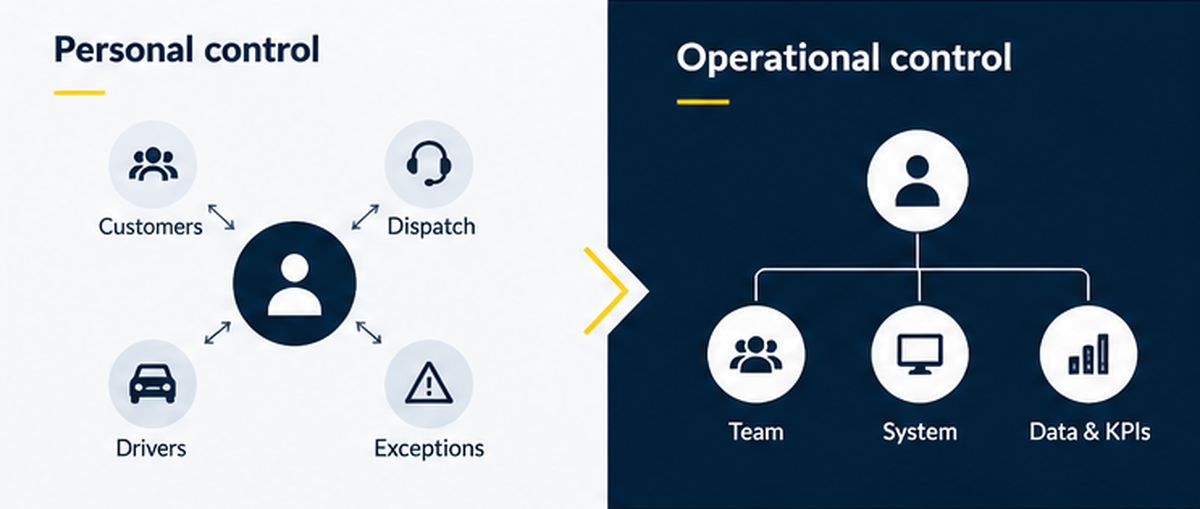
McKinsey makes a similar point in its work on scaling leadership: if increasingly granular daily decisions continue flowing to senior leadership as the company grows, decision-making eventually becomes too slow for the organization. McKinsey & Company
The leadership team should increasingly be working on the operation and strategy, rather than spending time on individual operational decisions.
Complexity grows faster than volume
A 50 percent increase in bookings does not necessarily mean 50 percent more operational complexity.
Operations rarely behave that neatly.
The standard booking is generally not what creates the difficulty. Complexity comes from everything that makes one booking different from another.
One corporate account may require specific vehicle classes and cost codes. Another may have its own pricing, notification, and reporting rules. Some trips can only be assigned to drivers with specific qualifications or permits. Pre-booked work may follow different assignment logic from ASAP jobs, and requirements can vary by location or contract.
The operation is no longer processing only trips. It is processing conditions around journeys.
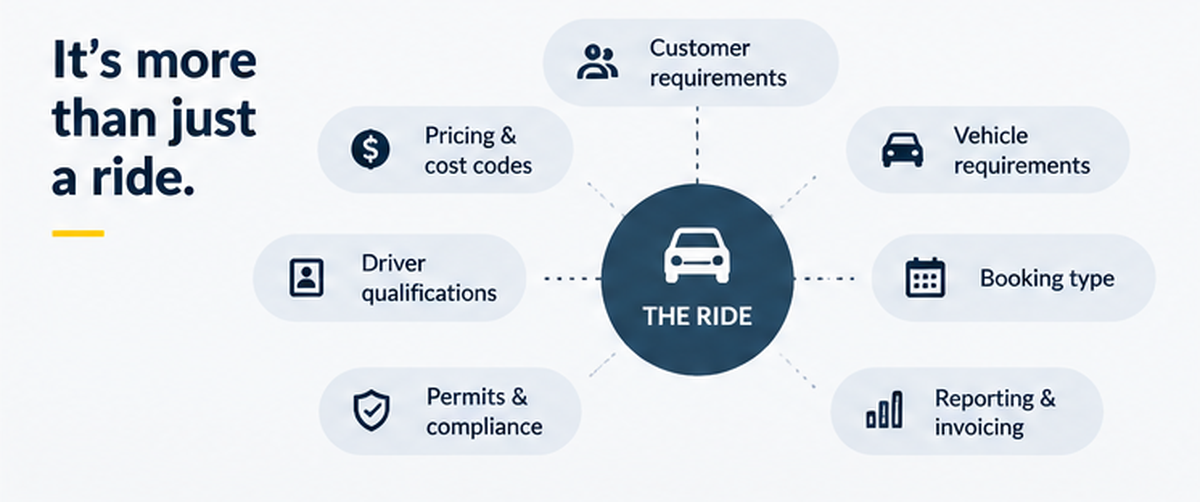
The difficult part of scaling is not the standard ride. It is the growing number of rides that are not standard. That distinction matters because adding people to manage each new layer of complexity is not only inefficient, but also not sustainable. At some point, the operating model itself has to become more scalable.
Work smarter, not harder becomes an economic requirement
Automation is often presented as a productivity feature. At scale, it becomes part of the economics of growth. A leadership team should be able to ask:
Does every increase in revenue require a similar (or more) cost in manual work?
If the answer is yes, the company may be growing, but it is not truly scaling.
The purpose of automation is not to remove human judgment. It is to stop skilled people repeatedly spending time on decisions and tasks that a well-configured system can handle consistently. That can include job assignment and passenger notifications, but it can extend much further.
Technology can automate job assignment and passenger notifications, but it can also reduce manual coordination elsewhere: planning routes and schedules, managing recurring transportation, tracking permits and checklists, applying operational rules, matching vehicle and driver requirements, and producing reports. Automation can also help standardize repeatable processes and free employees to focus on higher-value work rather than routine administration.
But automation only creates value if people trust it.
An automated decision that nobody understands can create a new kind of operational friction. Teams need visibility into how rules work, confidence that the system is behaving as intended, and the ability to intervene when reality changes, or doesn’t fit the rule.
The strongest operating model is therefore not automation versus human control. It is automation where consistency and scale matter, combined with human judgment where context matters.
The objective is not to automate everything. It is to make sure growth increases revenue faster than it increases operational effort.
Growth creates an administrative shadow
Every expansion has a visible side and a less visible one. The visible side may be another twenty vehicles, a new service area, or a valuable corporate or student transportation contract.
Behind it comes administration.
Driver payments. Invoicing. Accounting. Training. Licences. Permits. Planning. Scheduling. Routing. Reporting. Customer-specific pricing. Compliance. New users. New workflows. More data. More documentation.
Let’s take corporate transportation as an example. A large corporate account may create attractive recurring revenue, but it can also introduce its own booking channels, cost centres, assignment rules, notifications, reporting requirements, and invoicing processes. None of these are necessarily problems. But they become problems when every new customer or contract requires another manual workaround.
The commercial opportunity and the operational burden need to scale at different rates.
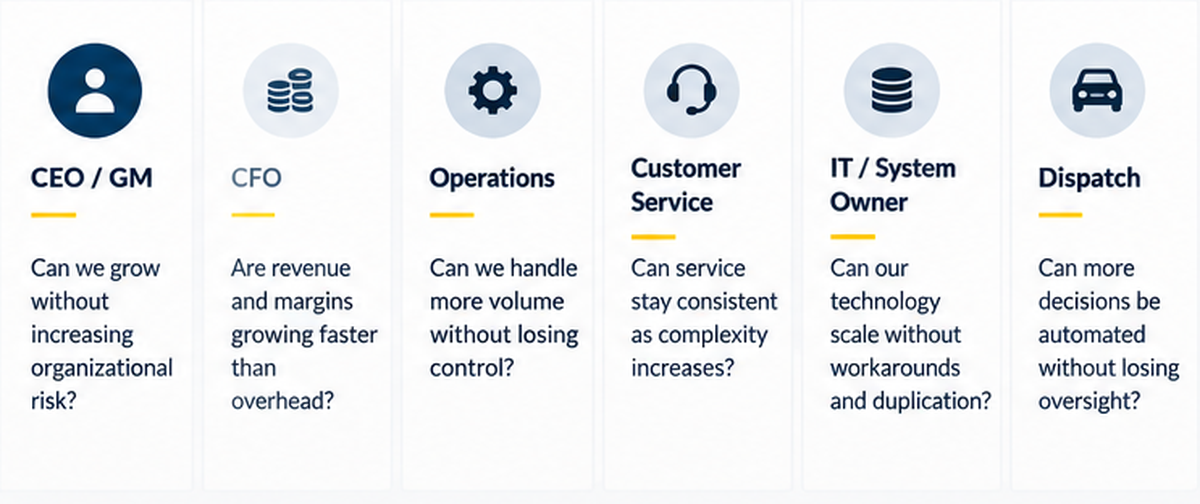
Different managers experience the same complexity differently
Growth rarely creates one single challenge. It creates different versions of the same underlying problem across the management team.
These may look like separate challenges. Usually, they are different symptoms of the same question:
Is the operation scaling as well as the business?
New services can change the operating model entirely
Diversification can be one of the most attractive routes to growth. An established taxi operator may expand into corporate transportation, airport contracts, NEMT or paratransit, student transportation, shuttle services, or other recurring contracted work.
But not every ride behaves like a taxi ride.
NEMT, student transportation, and shuttle operations can be significantly more schedule-driven. They may involve recurring journeys, route planning, multiple stops, passenger lists, specific driver or vehicle requirements, permits, checklists, no-shows, check-in and check-out procedures, and detailed performance requirements.
In the United States, NEMT can also involve specific state-level rules and acceptance criteria for drivers and vehicles.
Adding a new service is therefore not necessarily a matter of adding another booking category. It can introduce an entirely different operating rhythm.
The strategic question becomes:
Can we open new revenue streams without creating a new operational island every time we do it?
At scale, technology becomes infrastructure
As a transportation business grows, dispatch technology becomes less like a standalone application and more like a hub for operational infrastructure. Bookings, drivers, customers, tariffs, corporate accounts, reporting, payments, routing, telephony, and other workflows increasingly depend on one another.
The most efficient technology architecture is not automatically the one with the greatest number of integrations. Many core transportation workflows can be handled within the same platform, reducing unnecessary fragmentation and the number of systems that have to be maintained. At the same time, larger operators may already depend on systems that they have good reasons to keep. An ERP. Accounting software. Telephony. A customer portal. A specialist booking source. A BI environment. Internal systems developed around the organization’s own processes.
A scalable platform should therefore provide both consolidation and choice.
It should cover enough of the transport operation internally to avoid unnecessary complexity, while APIs and integrations should make it possible to retain and connect external systems where they continue to add value.
In practice, this means technology should adapt to the operating model rather than forcing the operating model to adapt to an arbitrary software boundary.
Management eventually outgrows gut feeling
Another inevitable consequence of growth is that leadership becomes further removed from individual transactions. That is healthy, provided the company replaces proximity with visibility. When senior managers can no longer personally observe everything happening across the operation, management information becomes more important.
Booking trends. Service performance. Vehicle utilisation. Customer profitability. Driver performance. On-time performance. Revenue patterns. Exceptions.
The organization becomes increasingly dependent on accurate reporting and relevant KPIs because management can no longer rely on personal observation to understand what is happening.
Recent research on operational excellence reinforces the importance of clear KPIs, real-time data, and transparent performance management as organizations become more complex. These provide a common view of performance and help teams make faster, better-informed decisions without every issue having to travel through senior management.
As the operation grows, leaders can no longer stay informed simply by being close to every job, customer, and dispatcher. Visibility has to come from shared data, clear KPIs, and reporting that allow the right people to see performance, exceptions, and risks without depending on one person’s direct involvement.
Good reporting does not replace experience. It allows experience to be applied to a much larger operation.
The hidden cost is not complexity. It is unmanaged complexity.
A larger transportation company will be complex. That is not a failure.
It may be complex precisely because it has won valuable contracts, expanded geographically, diversified its services, added booking channels, and built a larger customer base. Trying to eliminate all complexity would also mean eliminating many of the opportunities that created the growth.
The real danger appears when the organization behind the business doesn’t keep up.
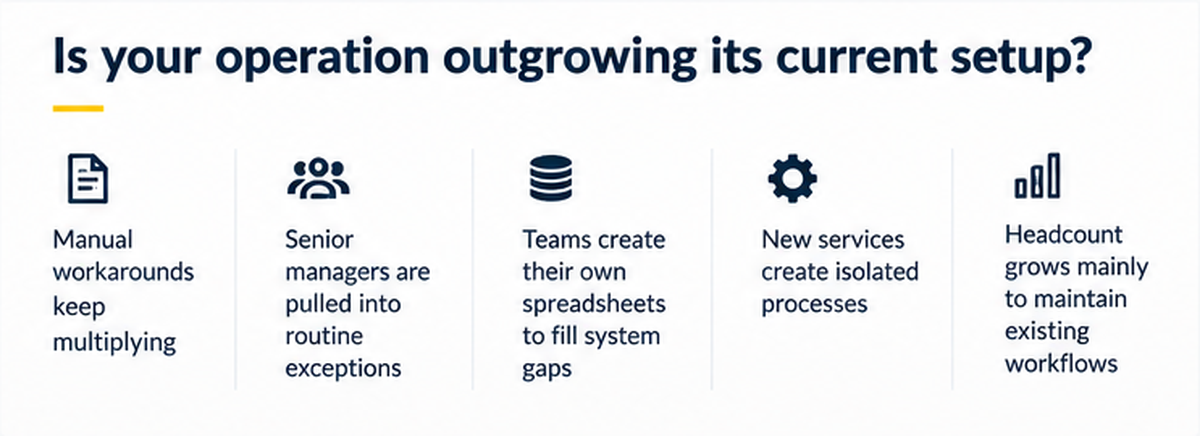
A system or operating model can be perfectly suitable for one stage of a company's development and restrictive at the next. That does not necessarily mean it failed. It can mean the business succeeded. The challenge is recognizing the transition before operational friction starts limiting the next stage of growth.
One platform. Every ride.
For transportation companies planning that next stage, scalability is not simply about adding another vehicle to a software subscription. It is about being able to increase volume, customers, booking channels, workflows, and service types without repeatedly rebuilding the operational foundation underneath them. That is the thinking behind TaxiCaller’s approach.
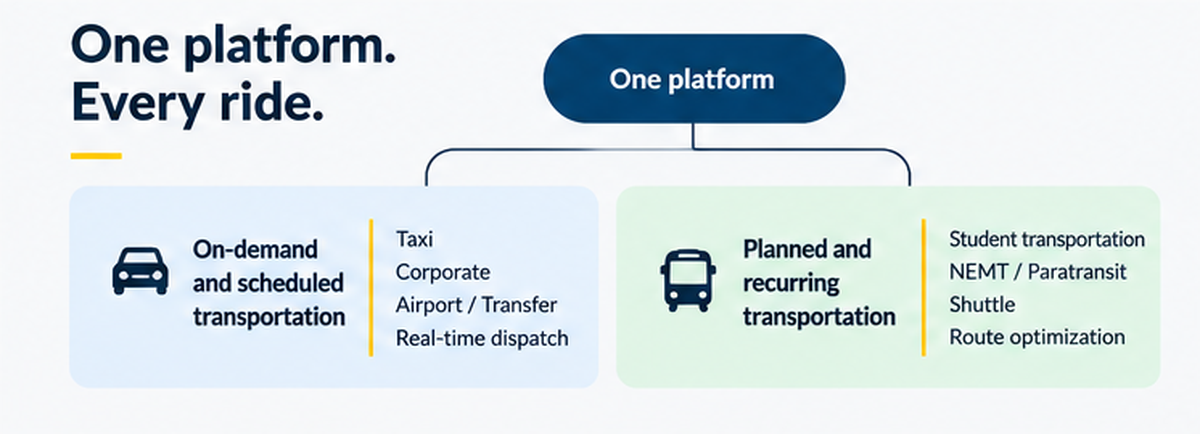
TaxiCaller and RouteMill operate as seamlessly integrated modules on the same platform, while addressing different operational needs.
TaxiCaller supports the real-time and on-demand side of transportation, including dispatch, booking channels, drivers, customers, corporate accounts, and reporting. RouteMill adds deeper planning, route optimisation, and scheduling capabilities for operations such as student transportation, NEMT/paratransit, shuttle, and other recurring services.
Different workflows do not have to mean disconnected systems.
And where operators already have external technology they want to retain, API and integration capabilities make it possible to connect those systems rather than replace them unnecessarily.
Checker Transportation in Detroit offers one example of how a larger operation can introduce a new platform progressively. The 150-vehicle operator implemented functionality in stages and trained its drivers and dispatchers as the new setup was introduced, rather than treating the change as a single technical switch.
The broader principle matters more than any individual feature: the technology should be able to grow into the operation the company is becoming.
Scalability means growing without rebuilding the operation
TaxiCaller is designed around 100% scalability, but scalability means more than technical capacity. It means supporting an operation as it adds vehicles, booking volume, users, customers, rules, services, and new ways of working without requiring the underlying structure to be rebuilt at every stage.
Technology is only part of that equation.
The organization also needs people who are capable of making decisions, processes that remain reliable at higher volumes, management information that provides visibility, and systems that automate the right work without hiding what is happening.
The goal is not to make a 100-vehicle operation behave as though it had 20 vehicles. Nor is the goal to eliminate complexity.
The goal is to build an operation capable of absorbing complexity without becoming fragile.
Because growth should make the business stronger. Not more dependent on individual people. Not more manual. Not harder to understand. And not progressively more expensive to control.
Your fleet may be growing. The question is whether the operation is becoming more scalable at the same time.
Talk to us about scaling your operation,
or
Book a Demo with a product specialist.